AI Share of Voice: How to Measure It and the AEO KPIs That Matter
Brands were named in 96% of branded answers but 13% of non-branded ones. Here is how to measure what actually matters.
AI share of voice is your brand's share of all brand mentions in AI-generated answers to a defined set of buyer questions, compared with your competitors. Measure it per engine, over repeated runs, and always split branded questions (your name is in the prompt) from non-branded ones. In GetCited platform data, brands were named in 96% of answers to branded questions but only 13% of non-branded ones, so a blended number can make visibility look several times better than it is.
This guide shows how to calculate AI share of voice, the AEO KPIs worth reporting, benchmarks from our data and a report structure for leadership.
What AI Share of Voice Means
In SEO, share of voice usually means your share of estimated clicks or impressions across a keyword set. In AI search there are no positions to count, so AI share of voice counts mentions instead:
AI share of voice = your brand's mentions ÷ mentions of all tracked brands (you plus competitors), across the same prompts, engines and runs.
It answers one question: when AI engines recommend brands in your category, how much of that attention goes to you?
How to Measure AI Share of Voice
- Build a prompt set of 30 to 100 real buyer questions: category questions ("best payroll software for a 20-person company"), comparison questions ("X vs Y") and a small set of branded questions. Tag each one branded or non-branded.
- Choose your engines (for example ChatGPT, Perplexity, Gemini, Claude, Google AI Overviews and AI Mode) and your competitor set.
- Run every prompt repeatedly on each engine, because answers change between runs. Our citation drift explainer covers why.
- Count mentions of your brand and each competitor in every answer, and record any linked sources.
- Calculate share of voice per engine and per question type, then trend it over time.
An illustrative example: across 40 non-branded prompts run three times on one engine (120 answers), your brand is named 18 times and three competitors are named 42, 30 and 30 times. Total mentions are 120, so your share of voice is 18 ÷ 120 = 15%, while your mention rate is 18 ÷ 120 answers = 15% as well. If a competitor appears twice in one answer, count it once per answer to keep the two measures comparable.
The Branded vs Non-Branded Trap: Our Data
GetCited platform data classified 1,327 AI answers for 13 brands by question type between September 19 and October 18, 2026.
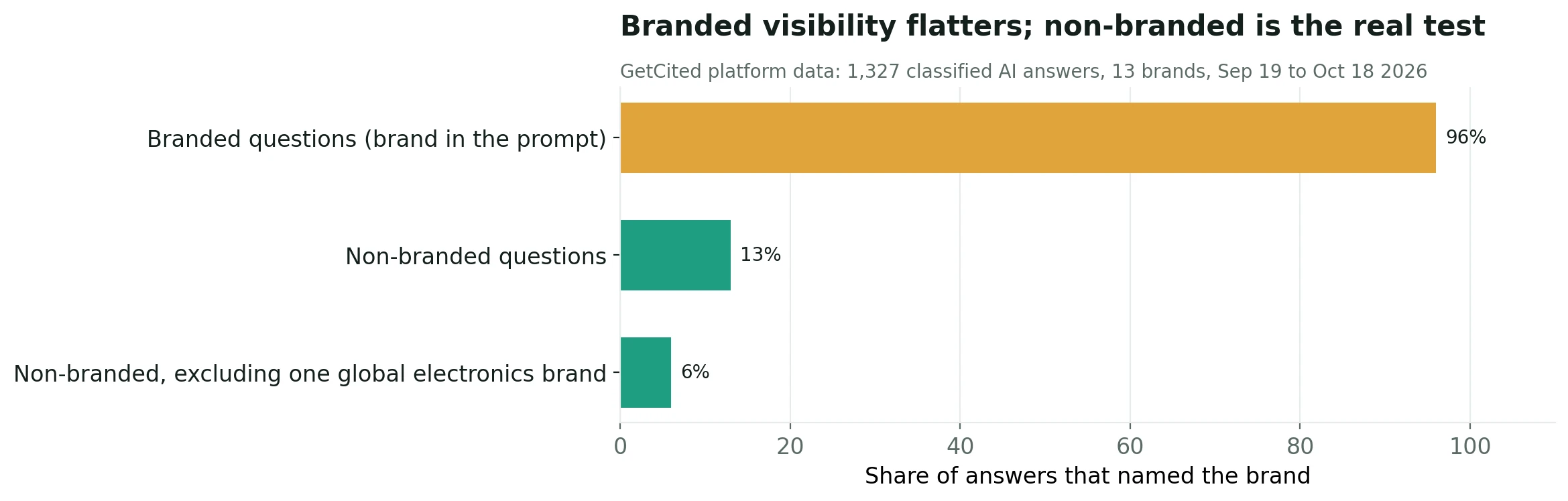
- On branded questions, brands were named in 96% of answers.
- On non-branded questions, only 13%, and 6% when one global consumer-electronics brand is excluded.
- 9 of the 13 brands were named in 0% of their non-branded answers.
- Blended together, the same answers give a figure of about 32%, a number that describes neither situation.
Branded visibility mostly tells you the engine recognises your name. Non-branded visibility tells you whether AI recommends you to people who do not know you yet, which is where new demand comes from. Report them as two separate lines, always.
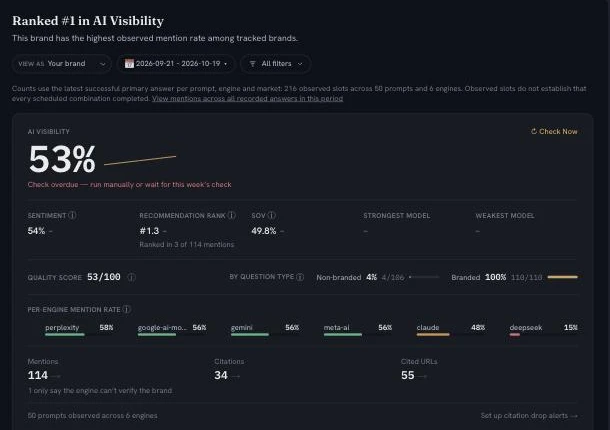
The same split shows up for a single brand in the GetCited Brand Insights view: 100% on branded questions, 4% on non-branded ones.
The AEO KPIs That Matter
| KPI | Definition | How to calculate | What to watch |
|---|---|---|---|
| Non-branded mention rate | How often AI names you when buyers don't ask for you | Answers naming you ÷ non-branded answers | Your main discoverability metric |
| AI share of voice | Your share of all brand mentions in your category | Your mentions ÷ all tracked brands' mentions | Trend against named competitors |
| Citation rate | How often AI links to your pages | Answers linking your site ÷ answers | Varies hugely by engine |
| Position in the answer | Whether you're named first, shortlisted or in passing | Average position when named | First mention carries the most weight |
| Sentiment and accuracy | How AI describes you, and whether the facts are right | Share of mentions by sentiment; wrong claims found | Negative or outdated claims |
| Cited pages | Which pages engines use for your category | Retrievals by URL and domain | Whether your pages or third parties lead |
| AI referral traffic | Visits from AI assistants to your site | Analytics referrals from AI domains | Outcome, though undercounted |
| Branded mention rate | Recognition when buyers ask for you | Answers naming you ÷ branded answers | A baseline, not a growth metric |
Benchmarks: Named vs Linked by Engine
Across 2,577 tracked answers for 15 brands and 10 engines (September 19 to October 18, 2026), brands were named in 29% of answers but their own site was linked in only 9%.
| Engine | Brand named | Own site linked |
|---|---|---|
| Google AI Mode | 33% | 26% |
| Perplexity | 29% | 26% |
| Google AI Overviews | 14% | 8% |
| Gemini | 29% | 2% |
| ChatGPT (without web search) | 35% | 3% |
| Claude | 32% | 0% |
| DeepSeek | 38% | 0% |
| Meta AI | 24% | 0.5% |
Mention rates were similar across engines, but links came almost entirely from engines that search the web and show sources. A KPI that only counts mentions misses whether AI ever sends anyone to your site. Treat these as reference points from our sample, not industry standards: each brand tracks its own prompts.
When brands were named, sentiment was mostly neutral: 64% neutral, 14% positive, 6% mixed and 2.4% negative, across 751 mentions. Neutral is not the same as accurate, so pair sentiment with an accuracy check; see ChatGPT has wrong information about your company.
How to Report AEO to Leadership
A one-page monthly report works best:
- Headline: non-branded mention rate and AI share of voice this month vs last, per engine that matters.
- Competitors: share of voice for you and your top three competitors on non-branded questions.
- Named vs linked: mention rate and citation rate side by side.
- Risks: negative or inaccurate claims found and what is being done.
- Work shipped: the fixes made this month and their before-and-after on the questions they targeted.
- Outcome: AI referral traffic and any leads attributed to AI.
Report trends over at least three months; single-month swings are often noise. If you already run an SEO dashboard, add these as a separate AI section rather than blending them in.
Common Measurement Mistakes
- Blending branded and non-branded questions into one visibility score.
- Single runs. One answer per prompt proves little; repeat runs and look at rates.
- One blended score across engines, which hides where you win and lose.
- Counting mentions only, without citations, position or accuracy.
- Prompt sets built from keywords rather than how buyers actually ask.
- Changing the prompt set every month, which breaks the trend line.
See Your Branded vs Non-Branded Split
Track share of voice, mention rate and citation rate per engine, with branded and non-branded questions reported separately.
See the AI visibility trackerFor the tracking method, see how to track brand mentions in ChatGPT and how to track AI citations; for tools, our best AI visibility trackers comparison.
Frequently Asked Questions
What is AI share of voice?
AI share of voice is your brand's share of all brand mentions in AI-generated answers to a defined set of buyer questions, compared with competitors. It is calculated as your mentions divided by the mentions of all tracked brands, per engine and over repeated runs.
How do you measure AI share of voice?
Build a set of real buyer questions tagged branded or non-branded, run them repeatedly on each AI engine you care about, count mentions of your brand and each competitor in every answer, and divide your mentions by the total. Track it per engine and per question type over time.
What AEO KPIs should I report?
Non-branded mention rate, AI share of voice against competitors, citation rate, position in the answer, sentiment and accuracy, the pages AI cites, and AI referral traffic. Report branded mention rate separately as a baseline.
Why should branded and non-branded prompts be reported separately?
Because they measure different things. In GetCited platform data, brands were named in 96% of answers to branded questions but only 13% of non-branded ones, and 9 of 13 brands were named in none of their non-branded answers. Blending the two produces a number that hides the real discoverability gap.
What is a good AI share of voice?
There is no universal benchmark, because it depends on your category, competitor set and prompts. Compare yourself with your direct competitors on the same prompts and engines, and focus on the trend in your non-branded share over time.
How is AI share of voice different from SEO share of voice?
SEO share of voice is usually based on rankings and estimated clicks across keywords. AI share of voice is based on how often your brand is named in generated answers across prompts, which change from run to run, so it must be measured as a rate over repeated runs.