ChatGPT Has Wrong Information About Your Company? How to Fix It
Most of what AI engines know about you comes from pages you don't control. Fix the source, not the answer.
If ChatGPT is giving wrong information about your company, the error is not random. AI engines build answers from what the model learned in training and, for engines that search, from pages they retrieve, and most of those pages are not yours. Fix the source of the wrong fact, not the answer: find every wrong claim, trace it to where it came from, correct that source, and re-check until the answers change.
This guide gives you a repeatable test across engines, the four root causes behind wrong answers, a fix for each, and the data on where AI engines actually get brand information.
Why AI Engines Get Facts About Your Company Wrong
AI engines do not look your business up the way a person checks your website. They generate an answer from a blend of training data, retrieved web pages and, in some products, live search results. When those sources disagree or go stale, the engine can repeat whichever version it saw most, not the most current one.
There are four root causes, and each needs a different fix:
- Stale model memory: the model learned a fact in training and has not updated it since. Common for prices, leadership changes and discontinued products.
- Outdated third-party sources: an old directory listing, press release, review site or comparison page says something different from your site, and the engine retrieves it.
- Entity confusion: the model mixes you up with a similarly named company, a former subsidiary or an unrelated brand.
- Thin or unclear information on your own site: key facts are buried, inconsistent between pages, or only stated in images and PDFs.
What the Data Shows About How AI Describes Brands
GetCited platform data covers 751 AI answers that named a brand, collected between September 19 and October 18, 2026 across 15 brands and 10 engines.
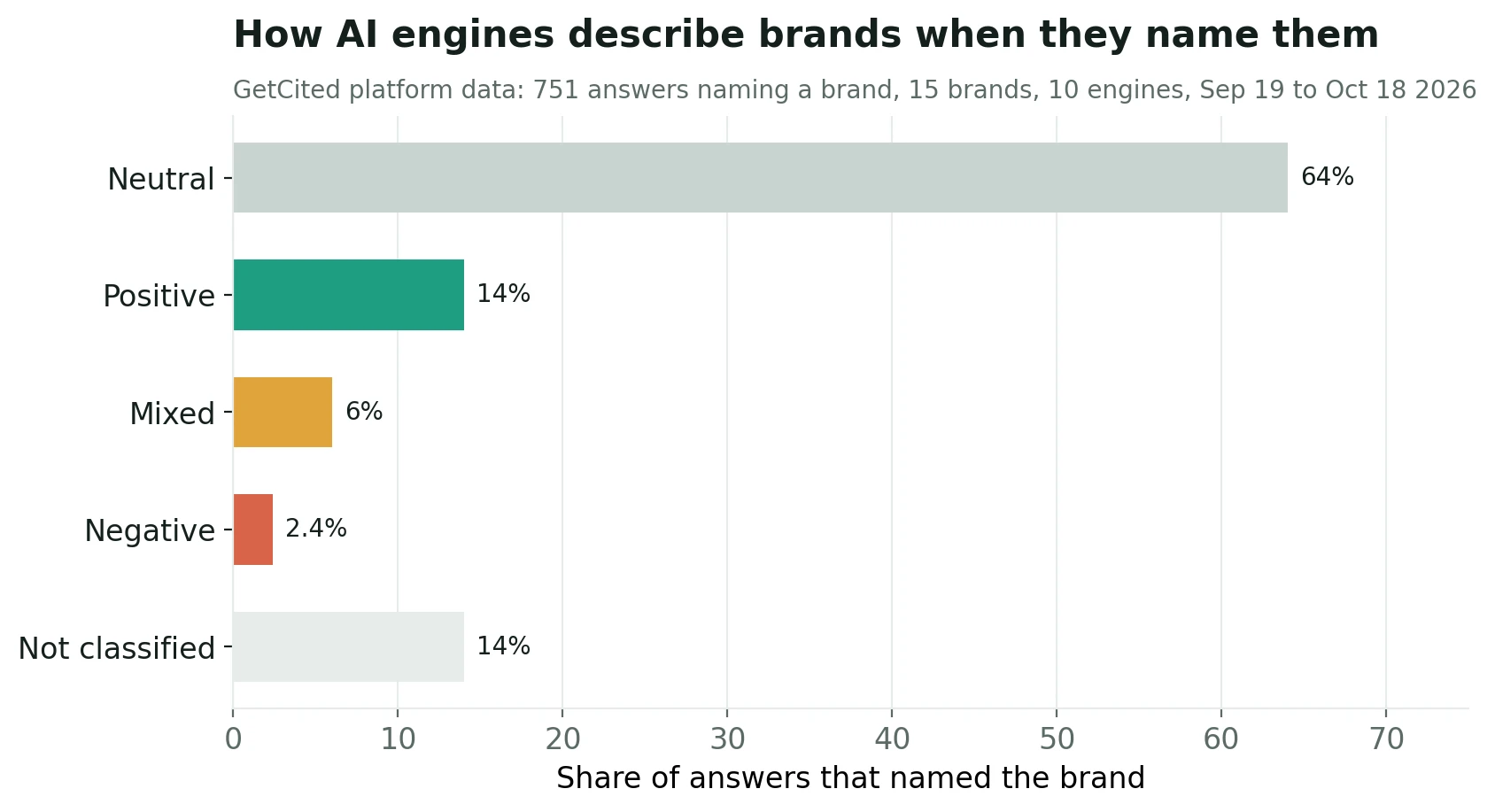
Most descriptions were neutral (64%), 14% positive, 6% mixed and 2.4% negative. In 2.8% of answers the engine said outright that it could not verify the brand. Negative answers are rare, but neutral is not the same as accurate: a calm, confident sentence with last year's price is still wrong.
The bigger issue is where engines get their information. Across 26,639 source retrievals tracked for 17 brands, only 4.4% came from the brand's own website. Editorial sites supplied 23.5%, user-generated content such as YouTube, Reddit and forums 11%, and competitors' pages 8.2%. Most of what an engine "knows" about you comes from pages you do not control, which is why fixing your homepage alone often changes nothing.
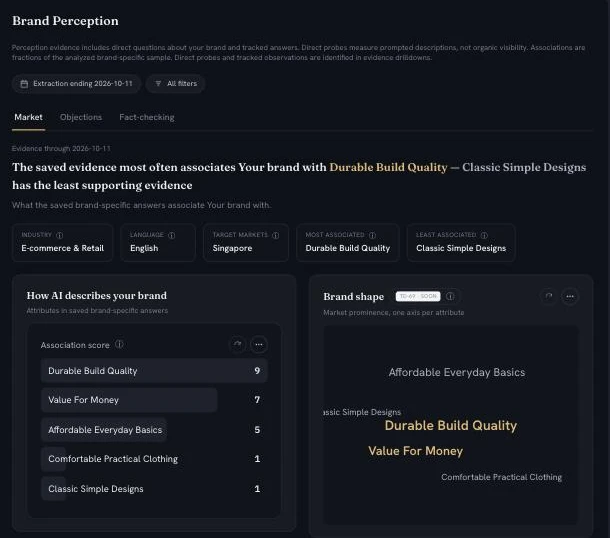
The GetCited Perception view shows the same thing for a single brand: the attributes AI associates with it, ranked by how often they come up, and which ones have the least supporting evidence.
Step 1: Find Every Wrong Claim
A single check of one engine misses most errors, because each engine retrieves and weights sources differently.
- Write 5 to 8 core questions buyers ask about you: what you do, pricing, who it is for, founding year and leadership, key features, and how you compare with your closest competitor.
- Run each question in ChatGPT, Perplexity, Gemini, Claude and Google's AI Mode, in fresh chats.
- Log the exact answer text, the date and any cited source word for word, not as a paraphrase. Screenshot the answer as evidence of the before state.
- Flag every claim that is wrong, outdated or unverifiable, and note which of the four root causes it most likely matches.
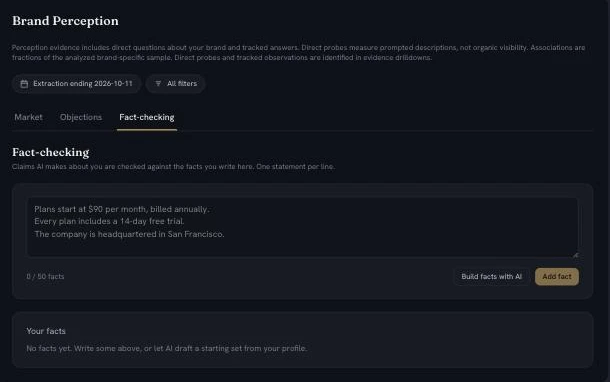
Before you start, write down the facts you want AI to get right. In GetCited this is the Fact-checking tab, where AI claims are checked against the statements you enter.
For an ongoing version of this check, see how to track brand mentions in ChatGPT.
Step 2: Trace Each Claim to Its Source
For engines that show sources (Perplexity, Google AI Mode, AI Overviews and ChatGPT when it searches), open the cited pages. Usually one of them states the wrong fact: an old review, a directory listing, a marketplace page or a news article.
For answers with no sources, the claim usually comes from model memory. Search the web for the exact wrong phrase, check your old pages and press releases, your profiles on review sites and directories, and Wikipedia or Wikidata if you have entries there. Whatever said it most often before the model's training cut-off is the likely origin.
| Root cause | Where to look | Typical fix |
|---|---|---|
| Stale model memory | Old press, old pricing pages, archived pages | Publish the current fact clearly and consistently; wait for retrieval or model updates |
| Outdated third-party source | The cited page, directories, review sites, marketplaces | Ask the publisher to update; update your own profiles |
| Entity confusion | Similar company names, old domains, subsidiaries | Disambiguation on your site, Organization schema with sameAs, consistent profiles |
| Thin information on your site | Your About, pricing and product pages | State facts plainly in HTML text with structured data |
Step 3: Fix the Source, Not the Answer
You cannot edit an AI answer directly. You can change what it is built from:
- Your own site: put every key fact in plain HTML text on one obvious page (About, Pricing, a facts or press page), keep it identical everywhere it appears, and add structured data. Our guide to schema markup for AI engines shows how.
- Pricing and features: make sure your own pages do not contradict each other. An engine that finds three different prices across your site, a partner page and a review site has no reliable way to pick the right one.
- Third-party sources: request corrections from publishers and directories, update review-site and marketplace profiles, and refresh old listings.
- Entity signals: use Organization schema with sameAs links to your official profiles, keep your name and description consistent, and add a short "not affiliated with" line if you are often confused with another company. Knowledge panel optimization and AI trust signals cover this in depth.
Step 4: Use the Engines' Own Feedback Tools
Most AI products let users rate an answer or report a problem, usually with a thumbs-down or feedback button. Use it for clear factual errors and include the correct fact and a source. Treat it as a supporting step, not the fix: feedback does not rewrite a specific answer on demand, and correcting the underlying sources is what changes answers over time.
Step 5: Re-Check Until the Answers Change
Run the same questions on the same engines after your fixes, and compare side by side with your before screenshots. Engines that search the web can reflect corrected sources once those pages are re-crawled. Answers that come from model memory can take longer, sometimes until a later model update. Our citation drift explainer covers why answers keep moving even after a fix.
Make this a monthly routine rather than a one-off cleanup. Automated AI visibility tracking removes the manual re-runs, and fix dispatch can push corrections to your CMS once a gap is found.
For Agencies Managing Many Brands
Running this test by hand for every client does not scale. Triage by risk: check brands in regulated or high-consideration categories weekly and others monthly. Look across clients too: when several brands show the same kind of error, the cause is often one shared source, such as a directory or comparison site, that you can fix once.
How to Prevent Wrong AI Answers
- Keep one canonical page that states your core facts plainly, and update it whenever they change.
- Add structured data to every page that carries a verifiable fact: pricing, locations, founders, product specs.
- Review third-party profiles and directories every quarter; together, editorial and user-generated sources made up more than a third of what AI engines retrieved in our data.
- Publish disambiguation content if you share a name with another company.
- Re-run your cross-engine test every month.
See How AI Engines Describe Your Brand
Get a free read on how AI engines currently talk about your business, before you start fixing.
Check my brand freeFrequently Asked Questions
Why is ChatGPT giving wrong information about my company?
Usually because the model learned an outdated fact in training, retrieved an outdated third-party page, confused you with a similarly named company, or could not find the fact clearly stated on your own site. In GetCited platform data, only 4.4% of the pages AI engines retrieved came from the brand's own website, so most information comes from sources the brand does not control.
How do I correct ChatGPT about my business?
You cannot edit an answer directly. Find the wrong claim, trace it to the source it came from, correct that source (your own pages, directories, review sites, publishers), use the product's feedback button for clear errors, and re-check the same questions until the answers change.
How long does it take to fix wrong information in AI answers?
It depends on the engine and the cause. Engines that search the web can reflect corrected pages once they are re-crawled. Facts that come from model memory can take longer, sometimes until a later model update. Re-check monthly and keep before-and-after evidence.
Why does Gemini say something different from ChatGPT about my company?
Each engine uses a different mix of training data and retrieved sources and weights them differently. Gemini and Google's AI features lean on Google's index, while ChatGPT answers from model memory unless it searches the web, so the same company can get a current answer in one engine and an outdated one in another.
Can anyone guarantee AI will stop getting my company wrong?
No. AI answers are generated fresh each time from sources no single company fully controls. What you can do is reduce how often errors appear by keeping your facts clear and consistent, correcting outdated sources and checking regularly.
What if AI confuses my company with another one?
Strengthen your entity signals: Organization schema with sameAs links to your official profiles, consistent naming and descriptions across the web, and a short disambiguation statement on your About page. Correct any third-party pages that mix the two companies up.