AEO vs GEO: What's the Difference and Which Should You Focus On?
Both terms mean getting used in AI answers. Our data from 2,577 AI answers shows the outcome that matters: named vs linked.
AEO (answer engine optimization) and GEO (generative engine optimization) both mean optimizing your brand and content so AI systems such as ChatGPT, Perplexity, Gemini and Google's AI Overviews use you in their answers. The difference is mostly emphasis: AEO grew out of featured snippets and voice search and focuses on being the direct answer, while GEO comes from research on generative engines and focuses on being retrieved, synthesized and cited. In practice they overlap so much that the label matters far less than the two outcomes you should measure: whether AI names your brand and whether it links to your site.
This guide defines both terms, shows how they relate to SEO, and uses GetCited platform data from 2,577 tracked AI answers to show why "named" and "linked" behave so differently across engines, and what to work on first.
AEO vs GEO in One Paragraph
AEO is the older term. It describes structuring content so an engine can lift a direct answer from it: a clear definition, an answer in the first sentence of a section, FAQs, lists and tables. GEO was popularised by academic work on "generative engines" in 2023 and describes making your content more likely to be retrieved and cited when an AI writes a synthesized answer from many sources. Most practitioners now use the terms interchangeably, and most tactics serve both.
| AEO | GEO | |
|---|---|---|
| Stands for | Answer engine optimization | Generative engine optimization |
| Roots | Featured snippets, voice assistants, People Also Ask | Research on generative search engines |
| Emphasis | Being the direct, quotable answer | Being retrieved, synthesized and cited among many sources |
| Typical tactics | Answer-first writing, FAQs, definitions, structured data | Authority, third-party coverage, citable facts, entity clarity |
| Shared ground | Crawlable pages, clear structure, trustworthy sources, schema | Same |
What AEO Means
Answer engine optimization means making it easy for an engine to extract a complete, correct answer from your page. The core habits:
- Put the direct answer in the first sentence or two of each section.
- Write self-contained definitions and steps that still make sense when lifted out.
- Use lists for steps and tables for comparisons.
- Add an FAQ for the follow-up questions buyers ask, with FAQPage schema to support it.
Our guide to AI search content optimization covers these in depth.
What GEO Means
Generative engine optimization means improving the odds that a generative engine retrieves your content, trusts it, and cites it when it writes an answer from several sources. Beyond on-page structure, GEO leans on signals outside your site: editorial coverage, reviews, community discussion, consistent entity information and pages that other sites already reference. Our guide to AI trust signals covers that off-site side.
The Real Difference: Being Named vs Being Linked
Whichever label you use, AI engines produce two different outcomes for a brand, and our data shows they behave very differently.
GetCited platform data covers 2,577 AI answers tracked for 15 brands across 10 AI engines between September 19 and October 18, 2026. Brands were named in 29% of answers, but their own site was linked as a source in only 9%. Brands are named about three times as often as they are linked.
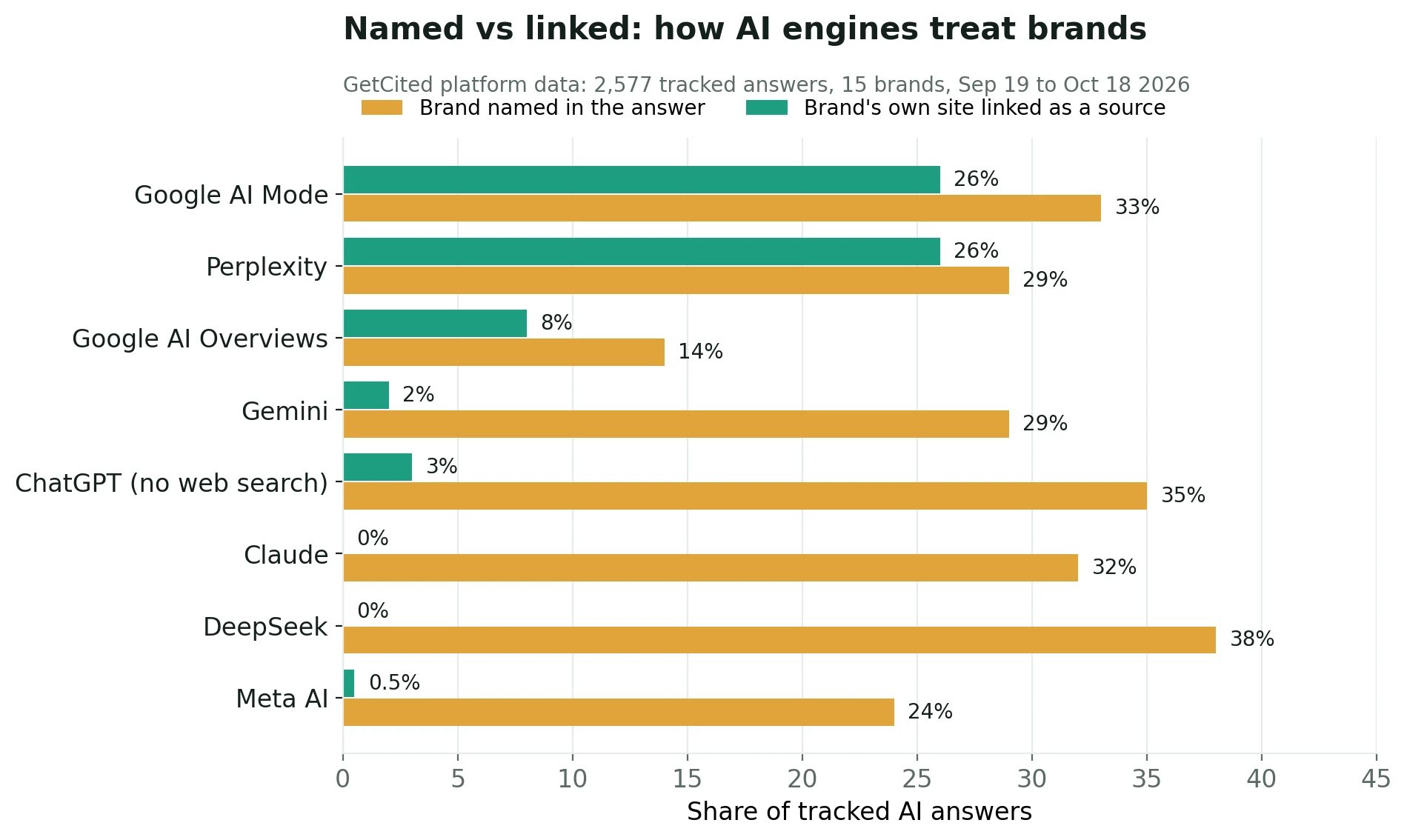
The gap depends on how each engine answers:
| Engine | Brand named | Own site linked |
|---|---|---|
| Google AI Mode | 33% | 26% |
| Perplexity | 29% | 26% |
| Google AI Overviews | 14% | 8% |
| Gemini | 29% | 2% |
| ChatGPT (without web search) | 35% | 3% |
| Claude | 32% | 0% |
| DeepSeek | 38% | 0% |
| Meta AI | 24% | 0.5% |
Engines that search the web and show sources (Google AI Mode, Perplexity, AI Overviews) are where links happen. Engines answering mostly from what the model already knows (Claude, DeepSeek, Meta AI, and ChatGPT without web search) name brands just as often but almost never link. Each brand tracks its own prompt set, so this is observational data rather than a controlled study, but the pattern is consistent.
Here is what that gap looks like for a single brand in the GetCited platform: 114 mentions, but only 34 citations and 55 cited URLs over the same period. Note the other split on the screen: 100% visibility on branded questions, 4% on non-branded ones.
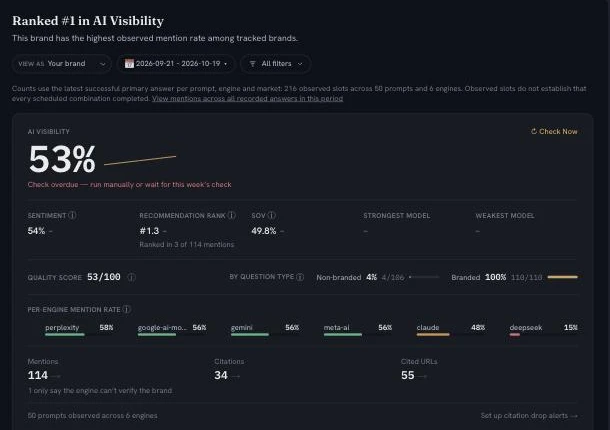
What this means in practice: being linked depends on being retrieved from the live web, so it rewards crawlable, citable pages and the sources that search-based engines read. Being named by memory-based engines depends on how often and how consistently your brand appears across the web the model learned from, which rewards long-term third-party presence.
Where AI Engines Get Their Sources
If you want to be linked, it helps to know what engines actually retrieve. GetCited platform data covers 26,639 source retrievals (13,772 distinct URLs) for 17 brands' tracked questions between July 19 and October 18, 2026.
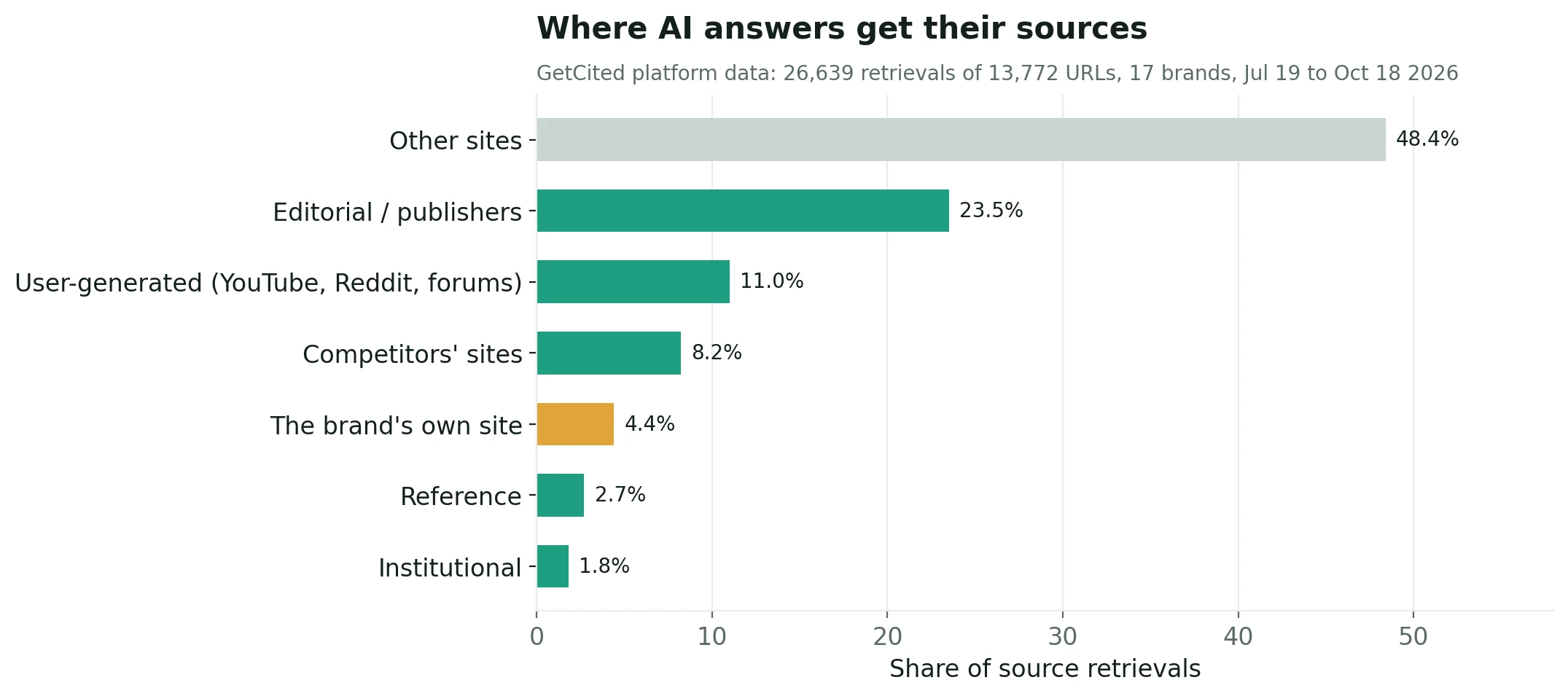
- The brand's own website was only 4.4% of retrievals.
- Editorial and publisher sites were 23.5%, user-generated content such as YouTube, Reddit and forums 11.0%, and competitors' sites 8.2%.
- By page type, articles were 16.2% and listicles 11.4%, well ahead of homepages (6.7%), category pages (3.6%) and product pages (2.8%).
Two conclusions follow. First, AEO-style work on your own pages matters, but your site is a small slice of what engines read, so GEO-style off-site work is not optional. Second, explanatory articles and list-style pages get retrieved far more than product pages, so if you want links, publish the formats engines already use.
How AEO and GEO Overlap With SEO
SEO, AEO and GEO share a foundation: pages that crawlers can reach and render, clear structure, structured data, and content worth trusting. Where they differ is the result you are aiming for.
| Discipline | Aims for | Main measure |
|---|---|---|
| SEO | A ranked position in search results | Rankings, clicks |
| AEO | Being the direct answer | Being named and quoted |
| GEO | Being retrieved and cited in a synthesized answer | Citations, share of voice |
Good SEO helps both: Google's AI features draw on the same index and ranking systems as classic results, and many AI engines search the web before answering. Our guides to AEO vs SEO and technical AI search optimization cover the shared foundation.
Which Should You Focus On?
Stop choosing between labels and choose by outcome and engine:
| Your situation | Focus first |
|---|---|
| Your buyers use Google AI Mode, AI Overviews or Perplexity | Linkable, answer-first pages on your site plus the editorial and list pages those engines retrieve |
| Your buyers use ChatGPT, Claude or Gemini without web search | Consistent third-party presence: reviews, community discussion, editorial coverage |
| You are rarely named on non-branded questions | Off-site authority and comparison-style content before polishing owned pages |
| You are named but rarely linked | Make your best pages the citable source: structure, schema, freshness |
| Small team, no budget | Fix crawl access and answer-first structure on your top pages, then earn a few third-party mentions |
A sensible order for most teams:
- Make sure AI crawlers can reach and read your key pages.
- Rewrite your most important pages answer-first, with FAQs and tables.
- Publish the formats engines retrieve: explanatory articles and fair comparison or list pages.
- Earn third-party mentions where engines already look: reviews, editorial roundups, community threads.
- Measure named and linked rates per engine, and repeat.
How to Measure AEO and GEO Separately
Track these per engine, on non-branded and branded questions separately:
Our guide to AI share of voice covers the formula and a leadership report template.
- Mention rate: the share of answers that name your brand.
- Citation rate: the share of answers that link to your pages.
- Share of voice: your mentions compared with competitors' on the same questions.
- Cited pages: which of your pages, and which third-party pages, engines rely on.
A blended score hides the most useful signal, which engine needs which kind of work. Our guides to how to track brand mentions in ChatGPT and how to track AI citations cover the method, and an AI visibility tracker automates it across engines.
See Whether AI Engines Can Read Your Site
Run the free AEO checker for a quick read on the technical and content basics both AEO and GEO depend on.
Run the free checkerFrequently Asked Questions
What is the difference between AEO and GEO?
AEO (answer engine optimization) focuses on making content easy for engines to use as a direct answer, while GEO (generative engine optimization) focuses on being retrieved and cited when an AI writes an answer from many sources. They overlap heavily and most tactics serve both; the more useful distinction is whether AI names your brand and whether it links to your site.
Is GEO the same as AEO?
Largely, yes. The terms come from different places, AEO from featured snippets and voice search and GEO from research on generative engines, but both aim to get a brand used in AI answers, and most practitioners use them interchangeably.
Does SEO still matter for AEO and GEO?
Yes. Crawlable pages, clear structure, structured data and trusted content underpin all three. Google's AI features draw on its search index, and many AI engines search the web before answering, so strong SEO makes AEO and GEO work easier.
Why does AI mention my brand but not link to my website?
Many AI engines answer from what the model already learned rather than searching the web, so they name brands without showing sources. In GetCited platform data covering 2,577 answers, brands were named in 29% of answers but linked in only 9%, and links came mainly from engines that search and show sources, such as Google AI Mode and Perplexity.
Should I focus on AEO or GEO first?
Choose by outcome and engine, not label. If your buyers use search-based engines such as Google AI Mode or Perplexity, start with citable, answer-first pages. If they use ChatGPT or Claude without web search, invest in consistent third-party presence. Most teams need both.
Does llms.txt help with AEO or GEO?
There is no evidence yet that it does. In GetCited platform data, none of 13,772 URLs that AI engines retrieved was an llms.txt file. Our llms.txt guide covers the data and who should still add one.