AEO Audit: What It Includes, What It Finds and What It Costs
Audits of 15 brands found the same pattern: AI can reach the site, but the pages aren't built to be cited.
An AEO audit checks whether AI engines such as ChatGPT, Perplexity, Gemini and Google AI Mode can reach your website, understand it and trust it enough to name and cite it. It covers four areas: technical access, content structure, off-site authority and your current visibility in AI answers. This guide explains what an AEO audit includes, what audits of 15 brands found, what an audit costs and how to prioritise the fixes.
What an AEO Audit Is
An AEO (answer engine optimization) audit is a structured review of everything that decides whether AI engines use your brand in their answers. A traditional SEO audit asks "can this page rank?". An AEO audit asks three different questions: can AI crawlers reach the page, can a model lift a clear answer from it, and do other sources back up what it says?
The terms AEO audit, AI visibility audit and GEO audit are used for much the same thing; see AEO vs GEO for how the terms relate.
What an AEO Audit Checks
| Area | What it checks | Why it matters |
|---|---|---|
| Technical | AI crawler access in robots.txt and firewalls, JavaScript rendering, status codes, canonicals, structured data, speed | If crawlers cannot reach or read a page, nothing else counts |
| Content | Answer-first sections, clear headings, definitions, lists and tables, FAQs, entity clarity, freshness | Engines quote passages, so pages must contain liftable answers |
| Authority | Third-party mentions, reviews, community discussion, editorial coverage, consistent entity data | Most sources AI engines retrieve are not your own site |
| AI visibility | Mention rate, citation rate and share of voice on real buyer questions, per engine | Shows whether the work is paying off and where competitors win |
Our guides go deeper on each: technical AI search optimization, AI search content optimization and AI trust signals.
What Audits Typically Find: Our Data
GetCited platform data covers the latest audits of 15 brands, run between August and October 2026, each scored from 0 to 100 per area.
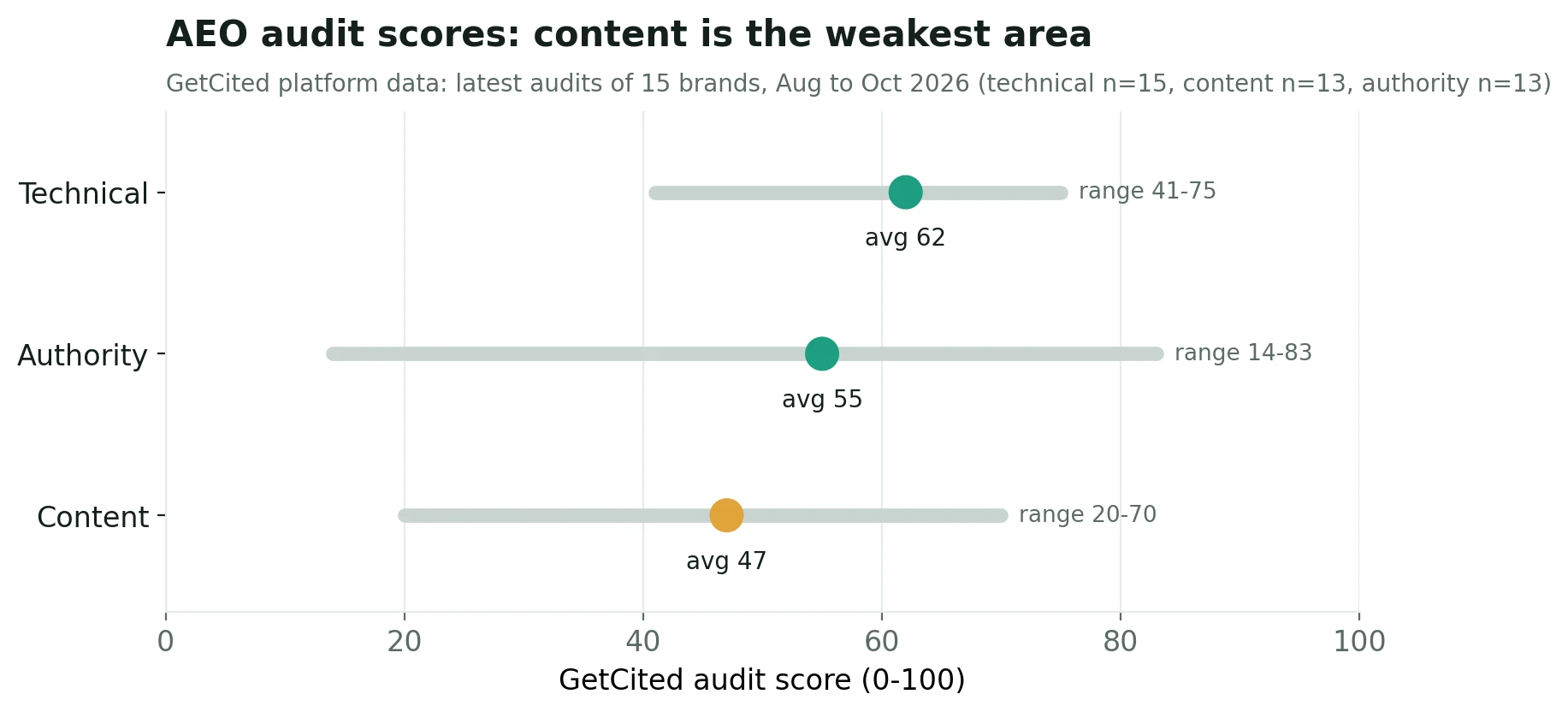
- Technical averaged 62 (range 41 to 75, 15 brands).
- Authority averaged 55 (range 14 to 83, 13 brands), the widest spread.
- Content averaged 47 (range 20 to 70, 13 brands), the weakest area on average.
The pattern is common: AI crawlers can reach the site, but the pages are not written in a way AI can quote, and third-party support varies hugely. Here is what that looks like in one anonymised brand's audit in the GetCited platform: an overall score of 70, with 122 of 254 checks needing work, split into Reach (technical access) 73, Structure (content and answer structure) 56 and Citation (off-site authority) 80.
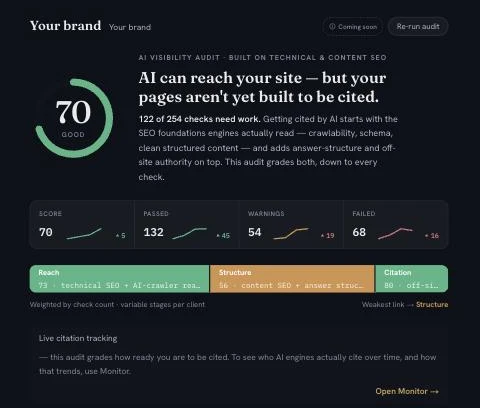
The verdict on that audit: "AI can reach your site, but your pages aren't yet built to be cited."
Visibility data tells the same story. Across 2,577 tracked AI answers, brands were named in 29% but their own site was linked in only 9%, and the brand's own website was just 4.4% of 26,639 pages AI engines retrieved. An audit that only looks at your own site misses most of what AI engines read.
How to Run an AEO Audit Step by Step
- Set a visibility baseline. Write 20 to 50 real buyer questions, run them on the engines that matter to you, and record mention rate, citation rate and which competitors and sources appear. Keep branded and non-branded questions separate.
- Check technical access. Review robots.txt for AI crawlers, firewall and CDN bot rules, rendering (does the content appear in the raw HTML?), status codes, canonicals and structured data. See our guide to AI crawlers and robots.txt.
- Review content on your most important pages. Does each section open with a direct answer? Are there definitions, comparison tables and FAQs? Are facts consistent and current?
- Review off-site authority. Which third-party pages do engines cite for your category? Are you on them? Check reviews, directories, editorial lists and community threads.
- Turn findings into a prioritised plan (below), with an owner and a date for each fix.
What an AEO Audit Costs
What you pay depends on whether you want a diagnosis, ongoing measurement, or the fixes done for you:
| Option | What you get | Cost drivers |
|---|---|---|
| DIY | A manual review using free tools and your own time | Your team's hours; hard to repeat consistently |
| Free checkers | A quick technical and content snapshot of one page or site | Free; limited depth, no tracking |
| Software | Automated audit plus ongoing AI visibility tracking | Number of prompts, engines, brands and how often checks run |
| Agency or managed audit | Expert interpretation plus the fixes built for you | Site size, number of brands, depth and how much implementation is included |
A free checker is the right start for a single site. Software makes sense when you need to repeat the audit and track results over time; GetCited plans start at $99 a month (see pricing). A managed audit and build makes sense when you need the work done, not just found; see our AEO build service.
How to Prioritise the Fixes
Score each finding by severity, likely impact on citations and effort, then work in this order:
- Crawl blockers first. Anything that stops AI crawlers reaching key pages: robots.txt rules, firewall blocks, content that only appears after JavaScript runs.
- Content structure on your highest-value pages. In our data content was the weakest area on average, so this is usually the biggest backlog. Rewrite key pages answer-first with tables and FAQs.
- Authority gaps. Get onto the editorial lists, review sites and community threads engines already cite for your category, and make your entity information consistent.
- Measure and repeat. Re-run the same buyer questions after each round of fixes and keep a before-and-after record per fix.
AEO Audit Checklist
| Check | Pass when |
|---|---|
| AI crawlers allowed | Search crawlers such as OAI-SearchBot, Claude-SearchBot and PerplexityBot are not blocked in robots.txt or the firewall |
| Content in raw HTML | Key text, prices and FAQs appear without running JavaScript |
| Structured data | Organization, Article or Product and FAQ schema match the visible page |
| Answer-first sections | Each key section opens with a direct, self-contained answer |
| Comparison content | Tables or comparison pages exist for the decisions buyers make |
| Fresh facts | Prices, features and dates are current and consistent across pages |
| Entity consistency | Name, description and profiles match across the web, with sameAs links |
| Third-party coverage | You appear on the review sites, lists and threads engines cite |
| Visibility baseline | Mention and citation rates recorded per engine, branded and non-branded separately |
| Fix log | Every fix has an owner, a date and a before-and-after |
Start With a Free AEO Check
Run the free AEO checker for a quick technical and content read on your site before a full audit.
Run the free checkerFrequently Asked Questions
What is an AEO audit?
An AEO audit reviews whether AI engines can reach your website, extract clear answers from it and trust it enough to name and cite it. It covers technical access, content structure, off-site authority and your current visibility in AI answers, rather than search rankings alone.
What does an AEO audit include?
Technical checks (AI crawler access, rendering, structured data), content checks (answer-first sections, definitions, tables, FAQs, freshness), authority checks (reviews, mentions, editorial coverage, entity consistency) and a visibility baseline showing how often AI engines name and link to you, per engine.
How much does an AEO audit cost?
A DIY audit costs only your team's time and free checkers cost nothing. Software that audits and tracks AI visibility is priced by prompts, engines, brands and how often checks run; GetCited plans start at $99 a month. Agency or managed audits cost more because they include expert interpretation and the fixes.
What do AEO audits usually find?
In GetCited audits of 15 brands between August and October 2026, content was the weakest area on average (47 out of 100), behind authority (55) and technical (62). Most sites were reachable by AI crawlers but their pages were not structured to be quoted.
Is an AEO audit the same as a GEO audit?
Largely, yes. Both assess how well a brand and its content perform in AI-generated answers, and the checks overlap almost entirely; the difference is mostly terminology.
How often should I run an AEO audit?
Run a full audit at least every quarter and track AI visibility continuously, because AI answers and the sources they draw on change over time.