ChatGPT Shopping: How to Get Your Products Recommended by AI
In our data, AI engines retrieved marketplaces and community sites more often than brands' own stores. Here is what to do about it.
To get your products recommended by ChatGPT shopping, Perplexity and Google AI Mode, make sure the engines can find accurate product data (feeds, structured data and clear product pages), and that your products appear where these engines look for opinions: marketplaces, reviews, editorial "best of" lists and community discussion. In our data, AI engines retrieved marketplaces and community sites more often than brands' own stores, so your own site is only part of the job.
This guide explains how AI shopping answers work, shows where AI engines actually source ecommerce answers, and gives a checklist for ecommerce and Shopify brands.
How AI Shopping Answers Work
When someone asks ChatGPT, Perplexity or Google AI Mode "what are the best running shoes for flat feet under $100?", the engine does not return ten links. It writes a short recommendation, often naming two to five products, and in shopping experiences it can show product cards with prices, images and where to buy.
To write that answer, the engine combines:
- Product data: names, prices, availability and specs from merchant feeds, retailer pages and structured data. Google's shopping results draw on Merchant Center product data, and OpenAI has introduced ways for merchants to share product information with ChatGPT; check each platform's current merchant documentation.
- Opinion sources: reviews, "best of" lists, comparison articles, YouTube reviews and Reddit threads that say which products are good for whom.
- Model knowledge: what the model already learned about brands and products in training.
Optimizing for AI shopping is therefore not about ranking one product page. It is about being one of the few products the engine has enough trustworthy, consistent evidence to name.
Where AI Gets Ecommerce Answers: Our Data
GetCited platform data covers 15,811 source retrievals for the tracked questions of 10 ecommerce brands (fashion, apparel, footwear, kids, skincare, wellness and consumer electronics) between July 19 and October 18, 2026.
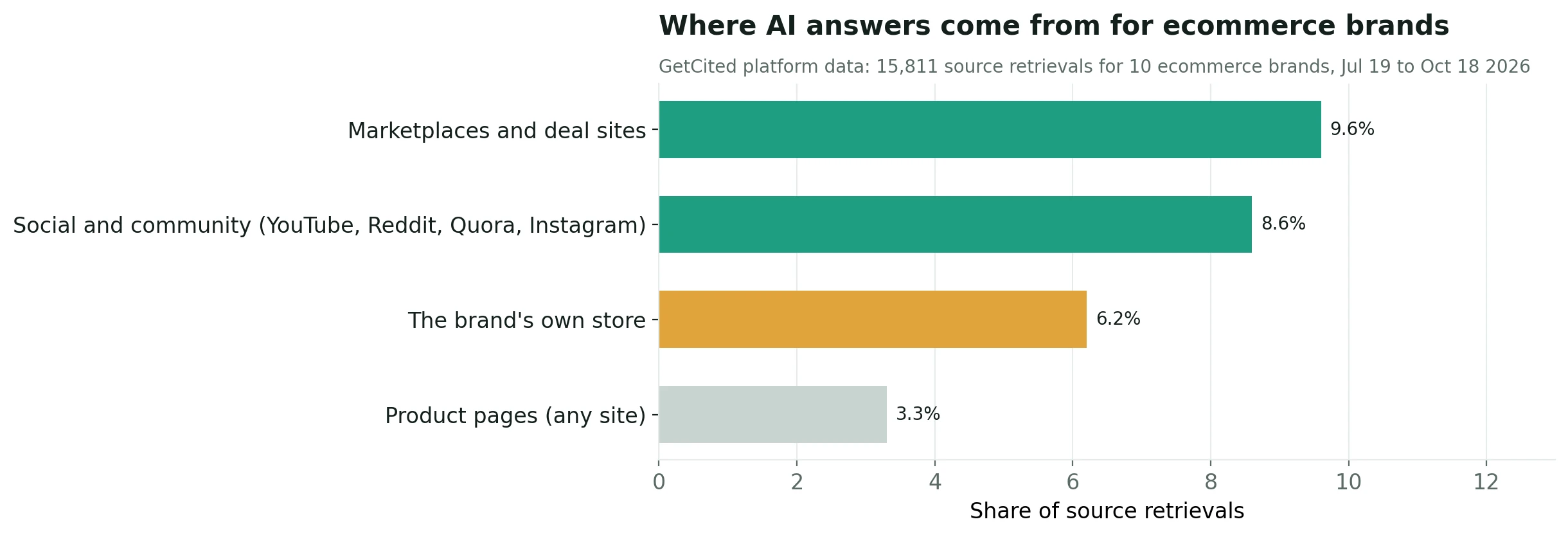
| Source type | Share of retrievals |
|---|---|
| Marketplaces and coupon or deal sites | 9.6% |
| Social and community sites (YouTube, Reddit, Quora, Instagram, Facebook) | 8.6% |
| The brand's own store | 6.2% |
| Product pages on any site | 3.3% |
The most-retrieved marketplaces in this sample included Flipkart, Myntra, Shopee, FirstCry, Nykaa Fashion and Lazada. Across all 17 brands we track, articles made up 16.2% of retrievals and listicles 11.4%.
What this means: AI engines pulled from marketplaces and community discussion more often than from the brand's own store, and product pages themselves were a small share of what they retrieved. Engines answering "which should I buy" lean on pages that compare and recommend. A brand that only polishes its own product pages is working on the smallest slice.
Product Data: Feeds, Schema and Product Pages
Get the facts right first, because engines repeat whatever product data they find:
- Product feeds: keep your Google Merchant Center feed complete and current, and use the merchant programs AI platforms offer where they are available to you.
- Structured data: add Product, Offer and AggregateRating schema to product pages so price, availability and ratings are machine-readable. See schema markup for AI engines.
- Product page content: write specific, factual descriptions that answer buyer questions: who it is for, sizes and fit, materials, care, compatibility, what is in the box. Our guide to optimizing product pages goes deeper.
- Consistency: use the same product names, prices and specs on your store, marketplaces and feeds. Conflicting data makes engines hedge or pick a competitor.
Marketplaces, Reviews and Retailers
Because marketplaces were retrieved more than brand stores in our data, list your products where your category is sold and keep those listings as complete as your own store: titles, images, specs, sizes and variants. Encourage genuine reviews on the platforms engines read, respond to them, and keep ratings visible. Inconsistent or thin marketplace listings can become the version of your product that AI repeats. Our guide to AI trust signals covers reviews and third-party presence in depth.
Editorial Lists and Creator Content
"Best X for Y" lists, gift guides, comparison articles, YouTube reviews and Reddit threads are where engines find opinions. Social and community sites alone were 8.6% of retrievals in our ecommerce sample.
- Find the lists and reviews that already appear for your category questions, and pitch your products to those publishers and creators.
- Send products to relevant reviewers and creators, and make it easy to cover you accurately with a press kit, spec sheet and images.
- Take part honestly in community discussions about your category, and do not plant reviews.
Shopify-Specific Steps
- Check that your theme outputs valid Product structured data on every product page, and that apps do not create duplicate or conflicting markup.
- Keep collection pages useful: a short buying guide at the top of a collection gives engines something to quote.
- Use a reviews app that shows ratings in HTML and in structured data.
- Connect your Google Merchant Center feed and keep it free of errors.
- Many Shopify stores now serve an auto-generated llms.txt file. In our data none of 13,772 URLs AI engines retrieved was an llms.txt file, so do not rely on it; see our llms.txt guide.
Our Shopify AEO page covers platform-specific help.
How to Track Product Visibility in AI
- Write product and category questions buyers ask, such as "best linen shirts for summer" or "which kids' shoes are best for wide feet", not just your brand name.
- Run them on each engine, repeatedly, and record which products and brands are named and which sources are cited.
- Compare with your competitors to find the questions where they are named and you are not.
- Fix the gap at the source (feed, product page, marketplace listing, review coverage or editorial list) and re-check the same questions afterwards.
Track per engine, because ChatGPT, Perplexity and Google AI Mode draw on different sources. Our guide to how to track brand mentions in ChatGPT covers the method, and the free ChatGPT citation checker gives a quick first look.
| Factor | Classic ecommerce SEO | AI shopping answers |
|---|---|---|
| Goal | Rank a product or category page | Be one of the few products named |
| Main sources | Your own pages | Feeds, marketplaces, reviews, lists, community |
| Winning content | Optimized product and category pages | Accurate product data plus comparison and review coverage |
| Measurement | Rankings and clicks | Mentions, citations and share of voice per engine |
See Which Products AI Recommends in Your Category
Track product and category questions across ChatGPT, Perplexity and Google AI Mode, and see who gets named instead of you.
See the AI visibility trackerFrequently Asked Questions
How do I get my products recommended by ChatGPT?
Make your product data accurate and complete (feeds, Product structured data, clear product pages) and get your products into the sources AI engines read for opinions: marketplaces, reviews, editorial "best of" lists, YouTube reviews and community discussions. In GetCited platform data, marketplaces and community sites were retrieved more often than brands' own stores.
Where does ChatGPT shopping get product information?
From product data shared by merchants and retailers, product pages and structured data on the web, reviews and comparison content, and what the model already knows. OpenAI and Google both offer merchant programs; check their current documentation for what is available to your store.
Does my Shopify store need anything special for AI shopping?
Make sure your theme outputs valid Product structured data, your reviews are visible in HTML, your Google Merchant Center feed is error-free and your product names and prices match across your store and marketplaces. An auto-generated llms.txt file is fine to keep but there is no evidence it helps.
Why does AI recommend marketplace listings instead of my store?
Marketplaces combine many products, prices and reviews in one place, which makes them useful sources for comparison questions. In our data, marketplaces and deal sites were 9.6% of retrievals for ecommerce brands, compared with 6.2% for the brands' own stores.
How do I know if AI engines recommend my products?
Run the product and category questions your buyers ask on each engine, several times, and record which products are named and which sources are cited. Repeat on a schedule and compare with competitors, or use an AI visibility tracker to automate it.